
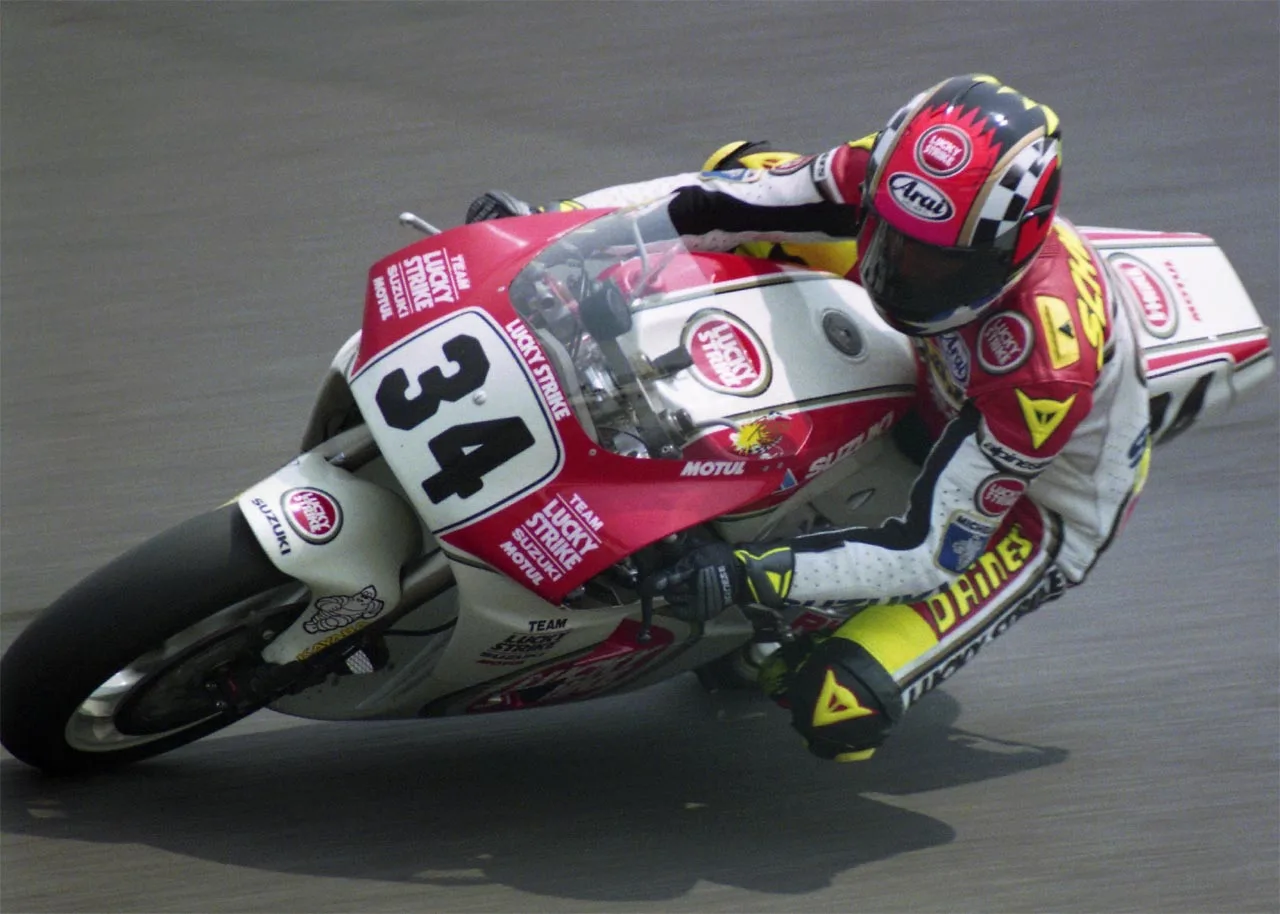
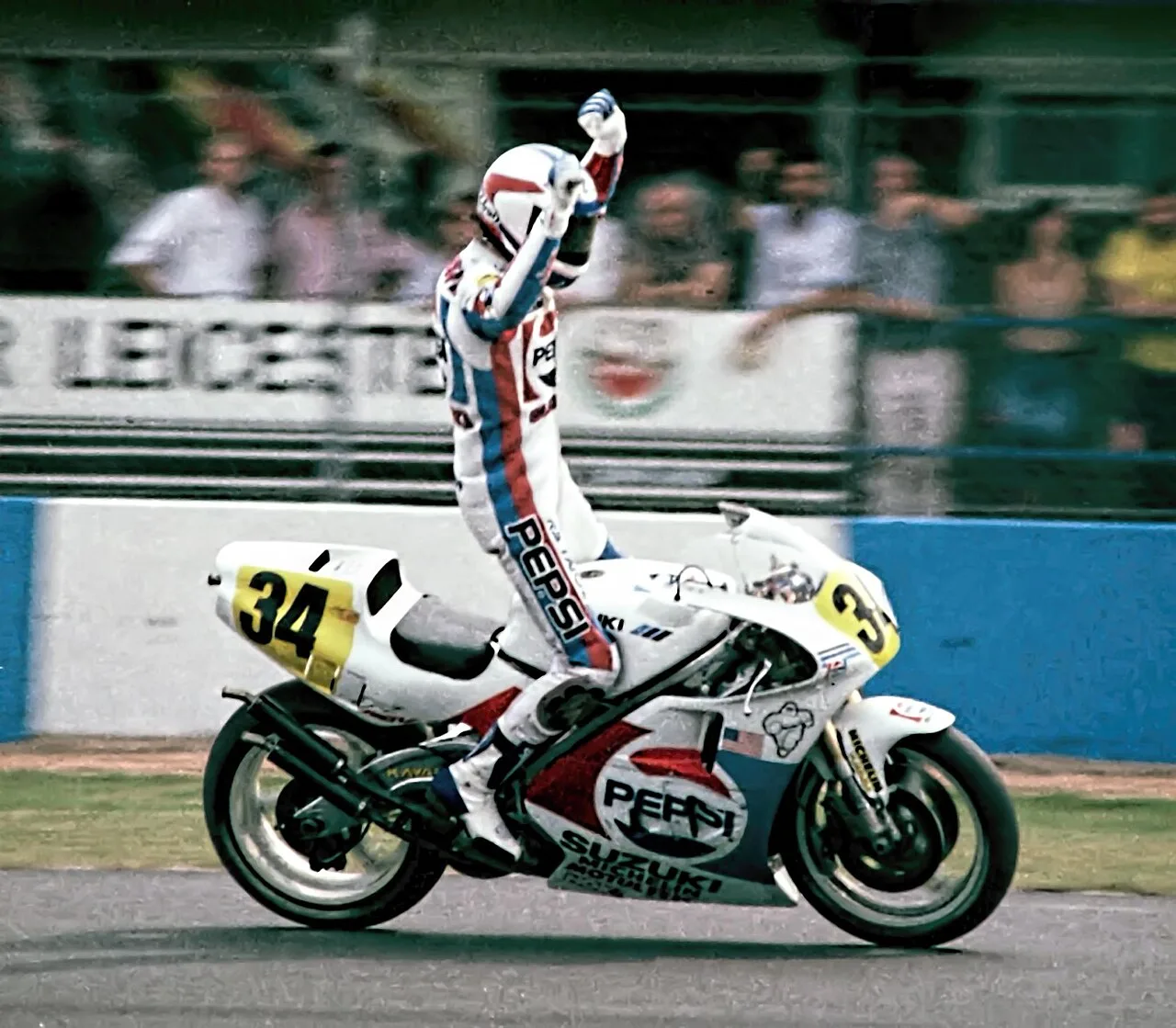
Kevin Schwantz is an American motorcycle racing legend best known for winning the 1993 500cc World Championship with Suzuki. His name is inseparable from the number 34, the Suzuki RGV500 and an attacking riding style that made every Grand Prix feel urgent.
Who is Kevin Schwantz?
Quick answer: Kevin Schwantz is a former American Grand Prix motorcycle racer and the 1993 500cc World Champion. MotoGP records him as a Suzuki loyalist who made his Grand Prix debut in 1986, became a full-time 500cc rider in 1988 and collected 25 premier-class victories. He is remembered as much for the commitment of his riding as for the title itself.
Born on June 19, 1964, Schwantz emerged during an exceptionally competitive period of premier-class racing. His regular opponents included Wayne Rainey, Eddie Lawson, Wayne Gardner and, later, Mick Doohan. The official MotoGP Kevin Schwantz profile describes how his spectacular approach built a worldwide following even before he secured the championship.
| Career fact | Verified detail | Why it matters |
|---|---|---|
| World championship | 1993 500cc World Champion | His sole world title came in motorcycle racing’s premier class. |
| Premier-class wins | 25 | MotoGP still uses his total as a benchmark when modern riders reach it. |
| Grand Prix manufacturer | Suzuki | Long-term continuity made rider, motorcycle and number 34 one enduring identity. |
| Signature number | 34 | The number became one of the most recognizable symbols of his racing career. |
Which motorcycles did Kevin Schwantz race?
The two most important answers are the Suzuki GSX-R750, which helped establish Schwantz in production-based superbike racing, and the Suzuki RGV500, the purpose-built Grand Prix machine tied to his 500cc wins and world championship. These motorcycles served different jobs: one was derived from a production supersport platform; the other was a prototype created for the highest level of Grand Prix competition.
Suzuki GSX-R750: the superbike foundation
Schwantz’s path to Grand Prix racing ran through Suzuki superbikes. Global Suzuki’s account of GSX-R competition history notes his successful 1986 UK Transatlantic Match Races debut on a GSX-R, five AMA Superbike wins and second place behind Wayne Rainey in 1987, followed by victory in the 1988 Daytona 200. That period matters because it formed both a manufacturer relationship and a rivalry that carried into the 500cc championship. See Global Suzuki’s GSX-R racing history for the manufacturer’s timeline.
Suzuki RGV500: the defining Kevin Schwantz motorcycle
When people search for the “Kevin Schwantz motorcycle,” they usually mean the number 34 Suzuki RGV500. Schwantz won the opening race of the 1988 season at Suzuka in his first year as a full-time 500cc Grand Prix rider. The RGV500 then evolved with him through race wins, crashes, a fierce rivalry with Rainey and the championship season of 1993.
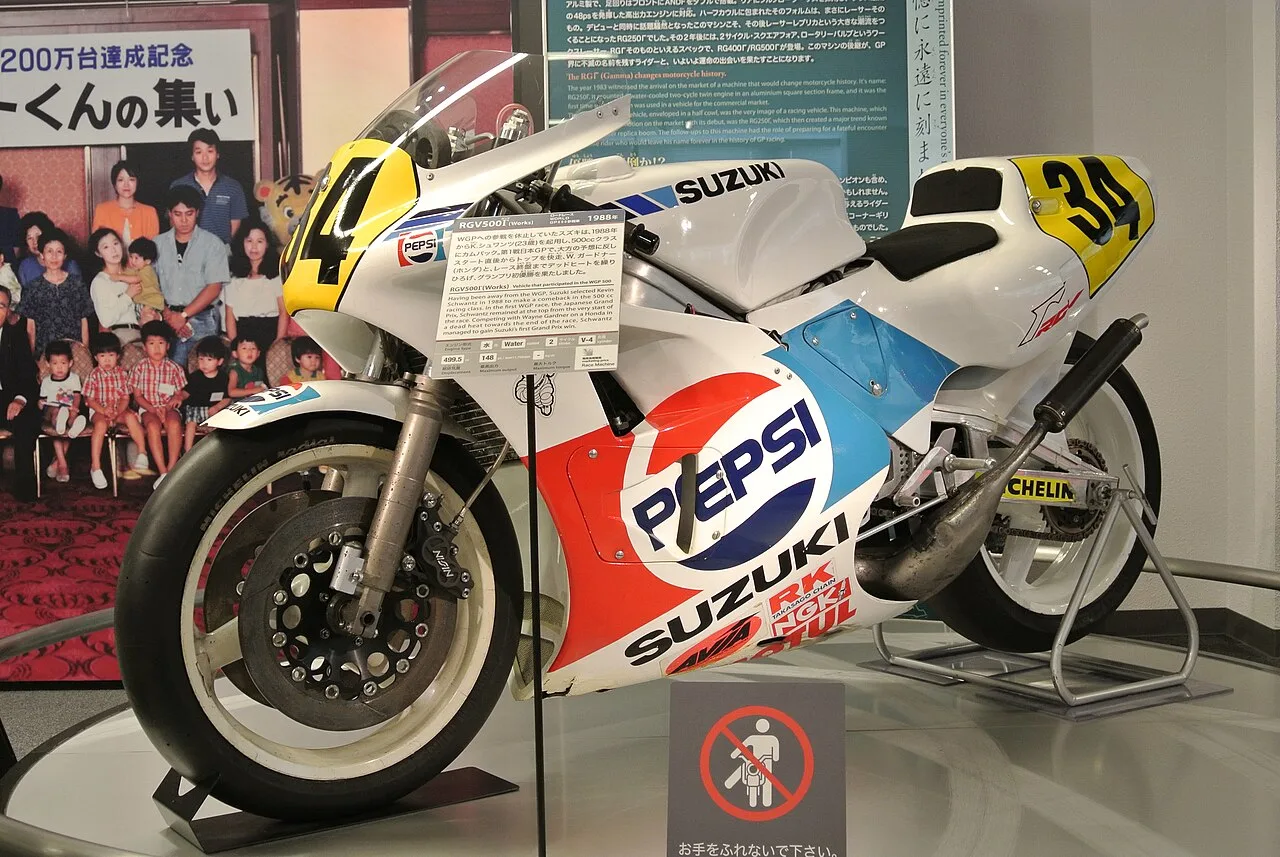
Why did the Kevin Schwantz RGV500 become so iconic?
The RGV500 became iconic because its story cannot be separated from Schwantz’s visible effort to extract a result. MotoGP’s biography credits him with eight wins across 1988 and 1989 and describes the late crashes that reinforced his reputation for brilliance without consistency. By 1990, the Schwantz–Rainey contest had become one of the defining rivalries of the era, contrasting the Suzuki rider’s flamboyant attack with his Yamaha opponent’s controlled accumulation of results.
The 1989 machine is a particularly vivid chapter. Suzuki’s restoration history states that Schwantz took six wins and three runner-up finishes that season, finishing first or second in every race he completed. The same source documents the restoration of his 1989 RGV500, evidence that the motorcycle is valued as a historic object as well as a racing tool.
How did Kevin Schwantz win the 1993 500cc World Championship?
Schwantz won the 1993 title by adding greater consistency to the speed that was already familiar. MotoGP’s career account says he adopted a more measured approach to results during the campaign. The season was also marked by Wayne Rainey’s career-ending accident at Misano, a human reality that makes the championship story more complicated than a simple points summary.
The title nevertheless represented years of development between Schwantz and Suzuki. He had progressed from a 1988 opening-round winner to a championship runner-up in 1990, then finally delivered Suzuki the 1993 crown. Injuries affected the following seasons, and he retired during 1995. His compact Grand Prix career left a large imprint because it compressed 25 victories, an intense rivalry and a world title into one manufacturer story.
What made Kevin Schwantz’s riding style distinctive?
Schwantz became famous for late braking, rapid changes of direction and a willingness to challenge for victory even when a safer points finish was available. That description should not be treated as riding advice: it belongs to the context of elite professional competition on closed circuits. For fans, the enduring appeal is the clarity of the story—number 34, Suzuki, commitment and a championship earned after several near misses.
His influence also reached beyond the original RGV500. Suzuki has noted that the compact 1,400 mm wheelbase of its 1996 GSX-R750 was based on the dimensions and ergonomics of Schwantz’s 1993 championship-winning Grand Prix motorcycle. That is a concrete example of the number 34 bike remaining relevant to later Suzuki design history.
Explore Kevin Schwantz-inspired fan products
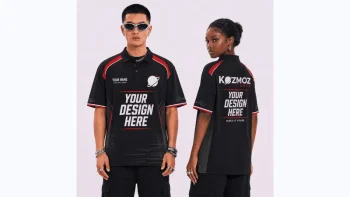
These two KozmozRacing listings are independent fan-expression costumes inspired by the 1993 Suzuki era. They are not official, licensed, sponsored, endorsed or affiliated merchandise, and they are not protective motorcycle equipment. Check each live page for current artwork, sizing, availability, production time, shipping and returns before ordering.

Kevin Schwantz Racing Costume Suit 1993 – Pepsi Suzuki
View Product
Kevin Schwantz Suzuki 1993 Collection Racing Costume
View ProductFor more rider-specific options, visit the verified Kevin Schwantz collection and check the live catalog for current availability.
Frequently asked questions
What motorcycle did Kevin Schwantz ride?
His defining Grand Prix motorcycle was the Suzuki RGV500, carrying number 34. Earlier, Suzuki GSX-R750 superbikes were important to his rise through production-based racing.
How many world championships did Kevin Schwantz win?
Kevin Schwantz won one motorcycle Grand Prix world championship: the 1993 500cc title with Suzuki.
How many 500cc Grand Prix races did Kevin Schwantz win?
He won 25 premier-class Grands Prix. MotoGP’s official coverage continues to use that total when comparing modern riders with Schwantz.
Why is Kevin Schwantz associated with number 34?
Number 34 was Schwantz’s signature racing number throughout the career that made him a Suzuki and motorcycle Grand Prix icon.
Are the featured products protective motorcycle racing suits?
No. They are independent fan-expression costumes, not certified safety gear for riding, track use, pit work or competition.
Sources and image credits
- MotoGP: Kevin Schwantz official rider profile and career story
- MotoGP: 25 premier-class wins benchmark
- Suzuki Press: restoration and 1989 RGV500 results
- Global Suzuki: GSX-R competition history
- Wikimedia Commons: Kevin Schwantz, 1993 Japanese Grand Prix
- Wikimedia Commons: Kevin Schwantz, 1989 British Grand Prix
- Wikimedia Commons: 1988 Suzuki RGV500