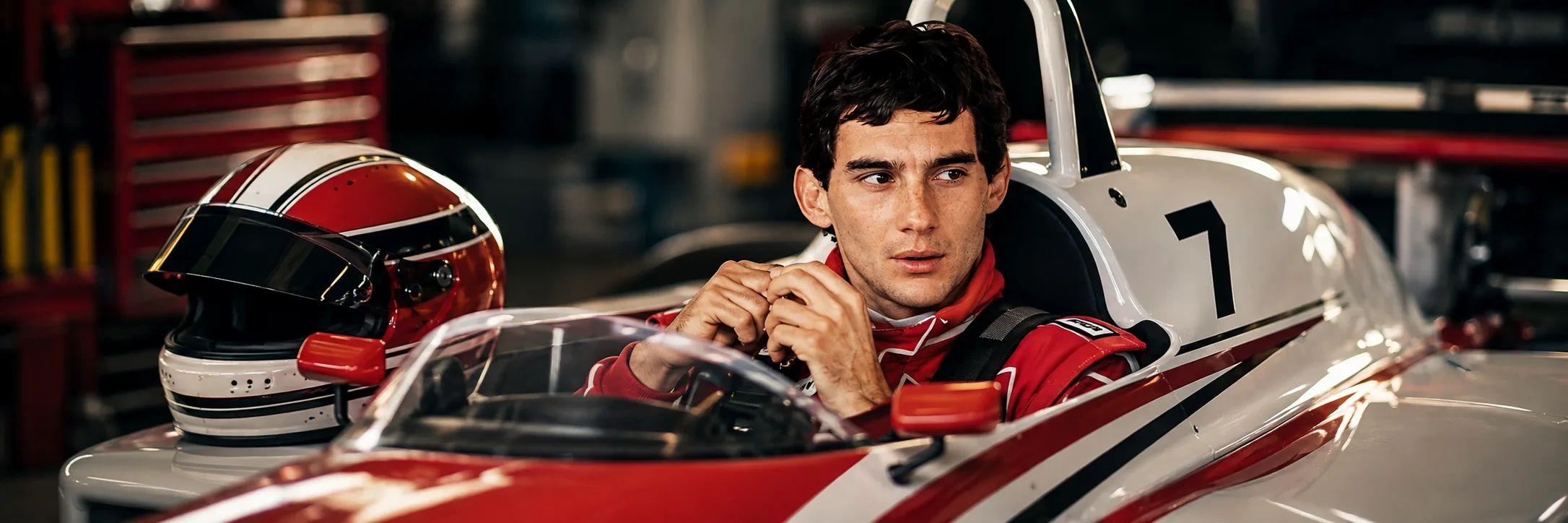


Photo: Ayrton Senna 1993 British Grand Prix by Martin Lee, licensed under CC BY-SA 2.0. Resized proportionally from the original; no other modifications.
🏁 The short version: Who Was Ayrton Senna & What Made Him Legendary?
Ayrton Senna da Silva (1960 – 1994) was a Brazilian racing driver and three-time Formula 1 World Champion (1988, 1990, 1991) widely regarded as the fastest and most influential driver in motorsport history. Across 161 Grand Prix starts, Ayrton Senna achieved 41 victories, 65 pole positions, and an unmatched 6 wins at the prestigious Monaco Grand Prix. Renowned for his otherworldly wet-weather car control, unmatched qualifying intensity, and fierce spiritual dedication, Senna transformed Formula 1 into a global spectacle.
| Key Career Highlights | Ayrton Senna Official Statistics |
|---|---|
| Full Legal Name | Ayrton Senna da Silva |
| Date & Place of Birth | March 21, 1960 – São Paulo, Brazil |
| F1 World Championships | 3 (1988, 1990, 1991 with McLaren-Honda) |
| Grand Prix Victories | 41 Wins across 161 Starts (25.5% Win Rate) |
| Career Pole Positions | 65 Pole Positions (40.4% Pole Rate) |
| Monaco GP Record | 6 Victories (All-Time F1 Record – “King of Monaco”) |
| Formula 1 Teams | Toleman (1984), Lotus (1985-87), McLaren (1988-93), Williams (1994) |
| Signature Colors | Yellow Helmet with Green and Blue Brazilian Stripes |
In the history of motorsport, few names evoke as much reverence, emotion, and sheer awe as Ayrton Senna. To millions of racing fans worldwide and across his beloved homeland of Brazil, Senna was far more than an elite athlete; he was a racing philosopher who treated the cockpit of a Formula 1 car as an instrument of pure perfection.
From his stunning wet-weather emergence on the streets of Monte Carlo in 1984 to his three dominant World Championships with McLaren-Honda, here is the complete story of Ayrton Senna, his incredible career milestones, and why his legacy continues to define racing greatness today.
1. Who Was Ayrton Senna? Full Name, Origins & Karting Mastery
Fans exploring the Brazilian icon often search for Ayrton Senna full name. He was born Ayrton Senna da Silva on March 21, 1960, in the Santana neighborhood of São Paulo, Brazil. In his early European junior career, he originally raced under his father’s surname, da Silva, before adopting his mother’s maiden name, Senna, because da Silva was extremely common in Brazil.
Senna’s journey began at age 4 behind the wheel of a small 1-hp go-kart built by his father, Milton da Silva. By age 13, he began competitive kart racing at the Interlagos kart track. It was during these formative karting years that Senna developed his legendary wet-weather prowess: after losing a rain-soaked club race due to poor kart setup, he made a personal vow to practice in torrential downpours until driving in the rain became his greatest weapon.
2. The Toleman Debut & The Legendary 1984 Monaco Wet Miracle
After dominating the 1983 British Formula 3 Championship against Martin Brundle, Ayrton Senna made his Formula 1 debut in 1984 with the modest, underfunded Toleman-Hart team.
The 1984 Monaco Grand Prix Miracle:
On June 3, 1984, torrential rain flooded the streets of Monte Carlo. Starting from 13th on the grid in a vastly underpowered Toleman TG184, 24-year-old Senna carved through the field with impossible precision, catching race leader Alain Prost at a rate of nearly 3 seconds per lap. While clerk of the course Jacky Ickx controversially stopped the race on lap 31 for safety, handing Prost the half-points victory, Senna’s 2nd-place podium announced to the entire world that a generational racing genius had arrived.

Photo: Ayrton Senna Spa-Francorchamps 1991 by George Voudouris, licensed under CC BY-SA 4.0. Resized proportionally from the original; no other modifications.
3. The Lotus Years & The Birth of The Qualifying Master (1985 – 1987)
Recognizing his supreme talent, Lotus signed Ayrton Senna for 1985 to drive the iconic black-and-gold John Player Special Lotus 97T. At the second race of the season in Estoril, Portugal, Senna took his first career pole position and delivered a rain-soaked masterclass, lapping every single competitor up to 2nd place to claim his first Formula 1 victory.
During his three seasons at Lotus (1985 – 1987), Senna claimed 6 Grand Prix wins and an astonishing 16 pole positions, establishing his trademark qualifying technique: aggressive throttle feathering (blipping the throttle mid-corner to keep the turbocharger spooled up at peak boost).
4. The McLaren-Honda Era: 3 World Championships & The Prost Rivalry
In 1988, Senna joined McLaren alongside two-time World Champion Alain Prost, armed with Gordon Murray’s legendary McLaren MP4/4 and Honda’s ferocious 1.5L turbocharged V6 engine. McLaren crushed the 1988 season, winning 15 out of 16 races, with Ayrton Senna winning 8 races to capture his first F1 World Championship at Suzuka.
- 1988 World Championship: Senna claimed his maiden crown after an epic charge from 14th to 1st at the Japanese Grand Prix following a stalled start.
- 1990 World Championship: In one of the most intense team rivalries in sport, Senna reclaimed the title with McLaren-Honda MP4/5B after a dramatic first-corner collision with Prost at Suzuka.
- 1991 World Championship: Senna dominated the 1991 season in the V12 McLaren MP4/6, sealing his 3rd World Championship and famously winning his emotional first home Brazilian Grand Prix with a gearbox jammed in 6th gear.

Photo: Ayrton Senna McLaren MP4-8 Silverstone 1993 by Martin Lee, licensed under CC BY-SA 2.0. Resized proportionally from the original; no other modifications.
Wear The Spirit Of Magic Senna
Original handcrafted sneakers celebrating Ayrton Senna’s historic liveries and Monaco Grand Prix mastery.


*Kozmozracing tribute items are independent custom designs celebrating Ayrton Senna and motorsport history.
5. Why Ayrton Senna Remains The Greatest: Wet Weather Genius & Legacy
Decades after his tragic passing at the 1994 San Marino Grand Prix in Imola, Ayrton Senna remains the benchmark against whom every modern Formula 1 driver is compared. Three factors elevate Senna above all other legends:
1. The “Lap of the Gods” (Donington Park 1993)
At the rain-swept 1993 European Grand Prix at Donington Park, driving an underpowered customer Ford V8 McLaren MP4/8 against the technologically dominant active-suspension Williams-Renaults of Alain Prost and Damon Hill, Senna dropped from 4th to 5th at the start before overtaking Michael Schumacher, Karl Wendlinger, Damon Hill, and Alain Prost to take the lead in a single opening lap widely considered the greatest lap in motorsport history.
2. The Undisputed King of Monaco
Senna won the Monaco Grand Prix a record 6 times (1987, 1989, 1990, 1991, 1992, 1993), including 5 consecutive victories for McLaren. His qualifying lap at Monaco in 1988, where he out-qualified teammate Alain Prost by 1.427 seconds, is legendary for Senna’s description of entering a spiritual subconscious state of driving.
3. Eternal Humanitarian Legacy (Instituto Ayrton Senna)
Beyond the racetrack, Senna donated tens of millions of dollars to combat child poverty in Brazil. Following his death, his sister Viviane Senna established the Instituto Ayrton Senna, which has provided quality education to over 30 million underprivileged Brazilian children.
6. Frequently Asked Questions (FAQ)
What was Ayrton Senna’s full name?
His full birth name was Ayrton Senna da Silva. He competed using his mother’s maiden name, Senna.
How many F1 World Championships did Ayrton Senna win?
Ayrton Senna won 3 Formula 1 World Drivers’ Championships in 1988, 1990, and 1991, all while driving for McLaren-Honda.
Why was Ayrton Senna called the “King of Monaco”?
Senna holds the all-time record of 6 victories at the prestigious Monaco Grand Prix, including an unbroken streak of 5 consecutive wins between 1989 and 1993.
How many pole positions did Ayrton Senna achieve?
Senna secured 65 career pole positions across 161 Grand Prix starts, achieving an astonishing 40.4% pole qualification rate.
Sources and further reading
- Formula 1 — official site — rules, hybrid power-unit technology and the current race calendar.
- FIA — Formula 1 regulations — official technical and sporting regulations governing F1 car design and race format.
- Ayrton Senna — career record, three world titles and full biography.