Jim Clark was a Scottish racing driver who won the Formula 1 World Championship in 1963 and 1965 and the Indianapolis 500 in 1965. Closely associated with Team Lotus and its founder Colin Chapman, Clark combined exceptional speed with mechanical sympathy and rare versatility. He won in Formula 1, Indy cars, Formula 2, touring cars and sports cars before his death at Hockenheim in 1968, aged 32.
Those headline facts explain what Clark achieved, but not why drivers, engineers and historians still place him among the greatest. His reputation rests on dominance in the machinery of his era, an unusually broad racing resume and a smooth technique that made difficult cars look settled. This guide follows his journey from the Scottish Borders to the summit of international motorsport.
Who was Jim Clark?
Jim Clark was one of the defining racing drivers of the 1960s. A farmer by background and a reluctant celebrity by temperament, he became the central driver in Lotus’s rise as a Formula 1 force. His two world championships only capture part of the story: Clark also won the Indianapolis 500, the British Saloon Car Championship and major Formula 2 and Tasman events. His ability to move between very different cars with little loss of speed distinguished him even in an era when drivers commonly entered several categories.
Clark’s career was inseparable from Lotus. Colin Chapman’s lightweight, innovative cars could be fast but demanding, and Clark’s sensitivity helped him exploit them without appearing theatrical at the wheel. The partnership produced landmark cars such as the Lotus 25, 33, 38 and 49. It also created a statistical peak: at the start of 1968, Clark held the Formula 1 records for Grand Prix victories and pole positions.
From a Scottish farm to international racing
James Clark Jr. grew up in a farming family in the Scottish Borders. According to Formula 1’s Hall of Fame profile, he was raised with four sisters and felt most at home on the family’s land. Racing began as an interest rather than a planned profession, and his family did not initially welcome the danger associated with the sport.
Clark competed in local rallies and club races during the 1950s, receiving important support from friend and entrant Ian Scott-Watson. His performances in cars including a Porsche 1600S quickly made his ability visible. In 1958 he raced for Border Reivers and won 12 of 20 starts, according to Motor Sport Magazine’s historical database. He was fast in sports cars and saloons before the wider motor-racing world knew his name.
A decisive encounter came at Brands Hatch in 1958. Clark raced a Lotus Elite against Colin Chapman, and his pace impressed the Lotus founder. The relationship developed into one of racing’s most consequential driver-constructor partnerships. Clark made his Formula 1 World Championship debut for Lotus at the 1960 Dutch Grand Prix and remained with the team throughout his Grand Prix career.
Why did the Clark Chapman partnership matter?
Chapman pursued low weight, compact packaging and technical innovation. Clark supplied precise feedback and the control required to make those ideas work at racing speed. The relationship was not simply a great driver placed in a fast car: each side amplified the other. Chapman gave Clark machinery capable of changing the sport, while Clark demonstrated its potential with an economy of motion that protected tyres and components.
The Lotus 25 illustrates the partnership. Introduced in 1962, its monocoque chassis was lower, lighter and more rigid than conventional space-frame rivals. Clark won three championship Grands Prix that season and entered the South African finale with a chance to take the title. An oil leak ended his race while he was leading, handing the championship to Graham Hill. The defeat made the scale of the following season even more striking.
Colin Chapman and Lotus 25-inspired fan apparel
The green-and-yellow identity associated with Chapman’s Lotus era remains one of classic motorsport’s most recognizable color combinations. These Kozmozracing polo shirts are independent, fan-created tribute designs for casual wear; they are not official Lotus, Jim Clark or Colin Chapman merchandise.
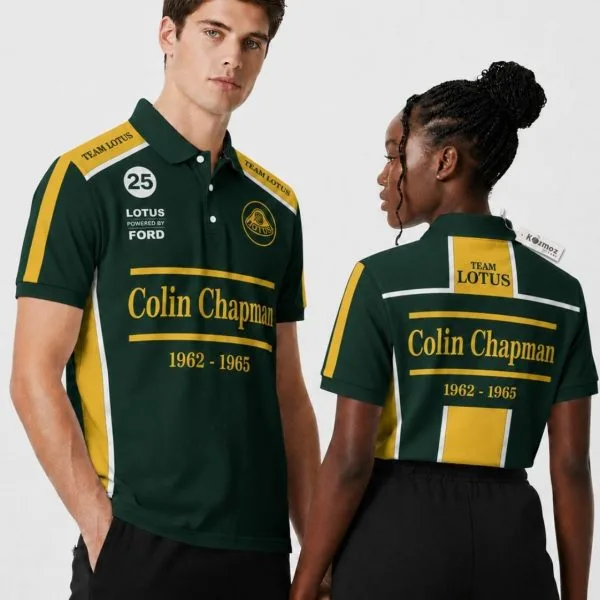
Colin Chapman Lotus 25 1962–1965 Green Yellow Custom Polo Shirt
A green-and-yellow fan-created polo inspired by the lightweight Lotus 25 era, made for casual motorsport wear.
View Product
Colin Chapman Lotus 25 1962–1965 Limited Edition Ver 2 Custom Polo Shirt
A second fan-created Lotus 25 tribute variation with limited-edition styling for classic racing enthusiasts.
View ProductIndependent fan tribute: These designs are created for motorsport enthusiasts and are not official, licensed, sponsored or endorsed by Lotus, Jim Clark’s estate or Colin Chapman’s estate.
How dominant was Jim Clark in Formula 1?
Clark won 25 of his 72 Formula 1 Grands Prix and started from pole 33 times. Raw totals have since been surpassed because modern calendars contain far more races, but his rates remain central to any fair assessment. He won more than one third of the championship Grands Prix he started and took pole at nearly half of them. He achieved those numbers in an age of fragile cars, limited safety equipment and a much higher risk of mechanical retirement.
| Achievement | Jim Clark’s record | Context |
|---|---|---|
| Formula 1 titles | 2 | Champion in 1963 and 1965 |
| Grand Prix wins | 25 | A record when he achieved his final victory in 1968 |
| Formula 1 poles | 33 | A record at the time of his death |
| Indianapolis 500 | 1 win | Won in 1965 after finishing second in 1963 |
| 1965 Indy laps led | 190 of 200 | Official Indianapolis Motor Speedway result |
For a deeper look at the numbers and the rules that shaped them, see Jim Clark’s career records. Statistics across eras should never be compared in isolation. Season length, reliability, points systems and the number of competitive teams all changed. Clark’s case is strongest when rate, dominance and versatility are considered together.
The 1963 World Championship
Clark’s first championship season was a display of sustained control. After retiring at Monaco, he won seven of the remaining nine championship races. Formula 1’s official profile records victories in Belgium, the Netherlands, France, Britain, Italy, Mexico and South Africa. He secured the title with races to spare, establishing a single-season win benchmark that stood for years.
The nature of the wins mattered. Clark could qualify at the front, build a lead and manage the Lotus without giving rivals an obvious opening. At Spa-Francorchamps, a circuit he reportedly disliked after earlier traumatic experiences, he nevertheless became a repeated winner. This separation between personal feeling and professional execution is part of what made his record exceptional.
Why was Jim Clark’s 1965 season so remarkable?
In 1965, Clark combined a second Formula 1 world title with victory at the Indianapolis 500 and championships in other categories. The achievement required switching between different cars, tracks and racing cultures while maintaining front-running performance. He won six of the first seven Formula 1 championship rounds he entered, clinching the title at the Nürburgring with three races remaining.
Clark skipped the Monaco Grand Prix because Indianapolis qualifying created a calendar conflict. That absence makes his Formula 1 dominance more impressive, not less: he still accumulated enough points to settle the championship early. Beyond Formula 1, his year included success in the Tasman Series and Formula 2. The breadth and concentration of achievement explain why historians often identify 1965 as one of the finest individual seasons in motor-racing history.
Explore the full calendar and its competing commitments in our guide to Jim Clark’s 1965 season.
How did Jim Clark win the 1965 Indianapolis 500?
Clark started the 1965 Indianapolis 500 from second position in the rear-engined No. 82 Lotus-Ford. The official Indianapolis Motor Speedway result shows that he completed all 200 laps, led 190 and averaged 150.686 mph. His control of the race made the victory decisive rather than opportunistic.
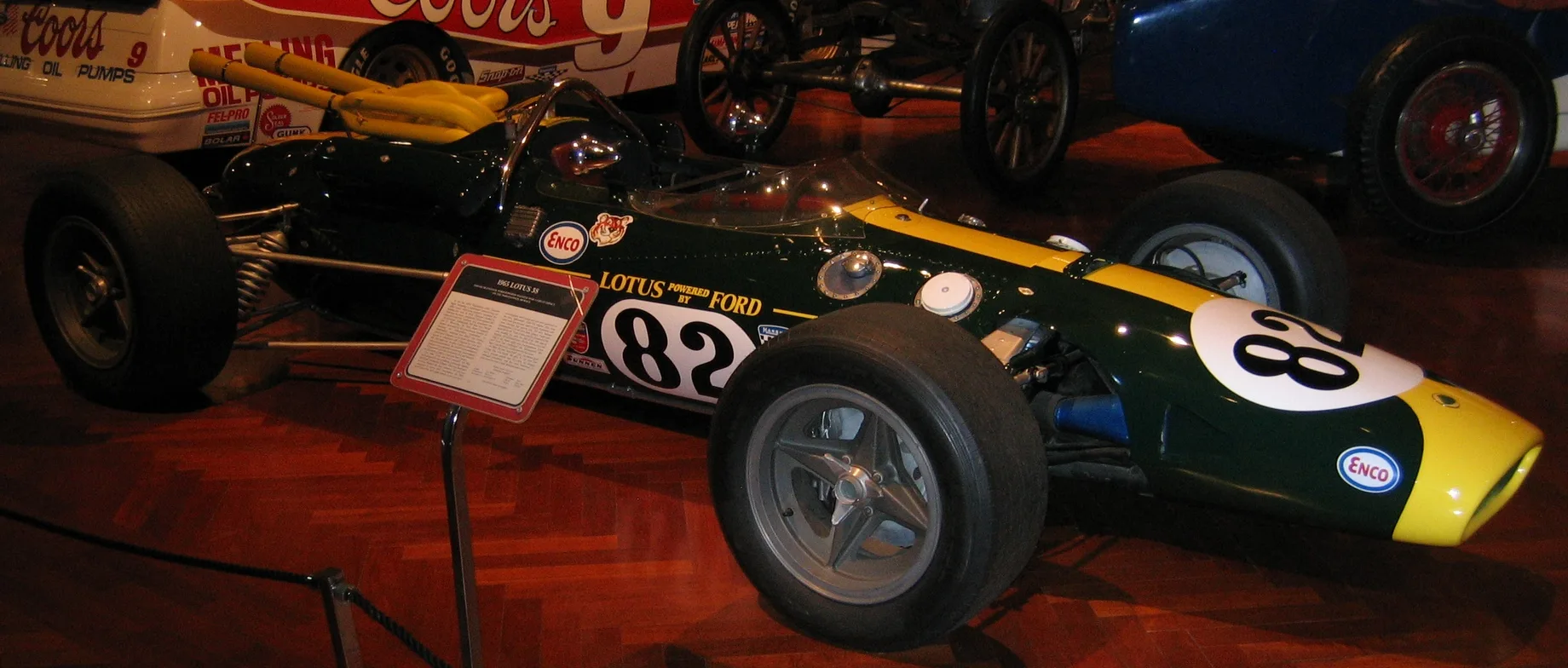
The win also marked a technological turning point. Indianapolis had long been dominated by front-engined roadsters. Clark’s success in the Lotus 38 demonstrated that the rear-engined layout had become the new competitive standard. Indianapolis Motor Speedway describes him as the first driver to win the race in a rear-engined car, although the transformation had already been developing through Lotus and other entrants.
Clark’s Indianapolis story began before 1965. He finished second on his debut in 1963 and started from pole in 1964 before suspension failure ended his race. Across five starts, the Speedway’s historical statistics credit him with one win, one pole and three top-five finishes. Read the race in detail in Jim Clark at the Indianapolis 500.
Which cars are most associated with Jim Clark?
Clark drove a wide range of machinery, but four Lotus models define major stages of his international career.
- Lotus 25: the monocoque Formula 1 car in which Clark won his first world championship in 1963.
- Lotus 33: a refined successor used during his dominant 1965 championship campaign.
- Lotus 38: the rear-engined Ford-powered car that carried him to victory at Indianapolis in 1965.
- Lotus 49: the landmark Formula 1 chassis built around the Cosworth DFV engine; Clark won its debut race at Zandvoort in 1967.
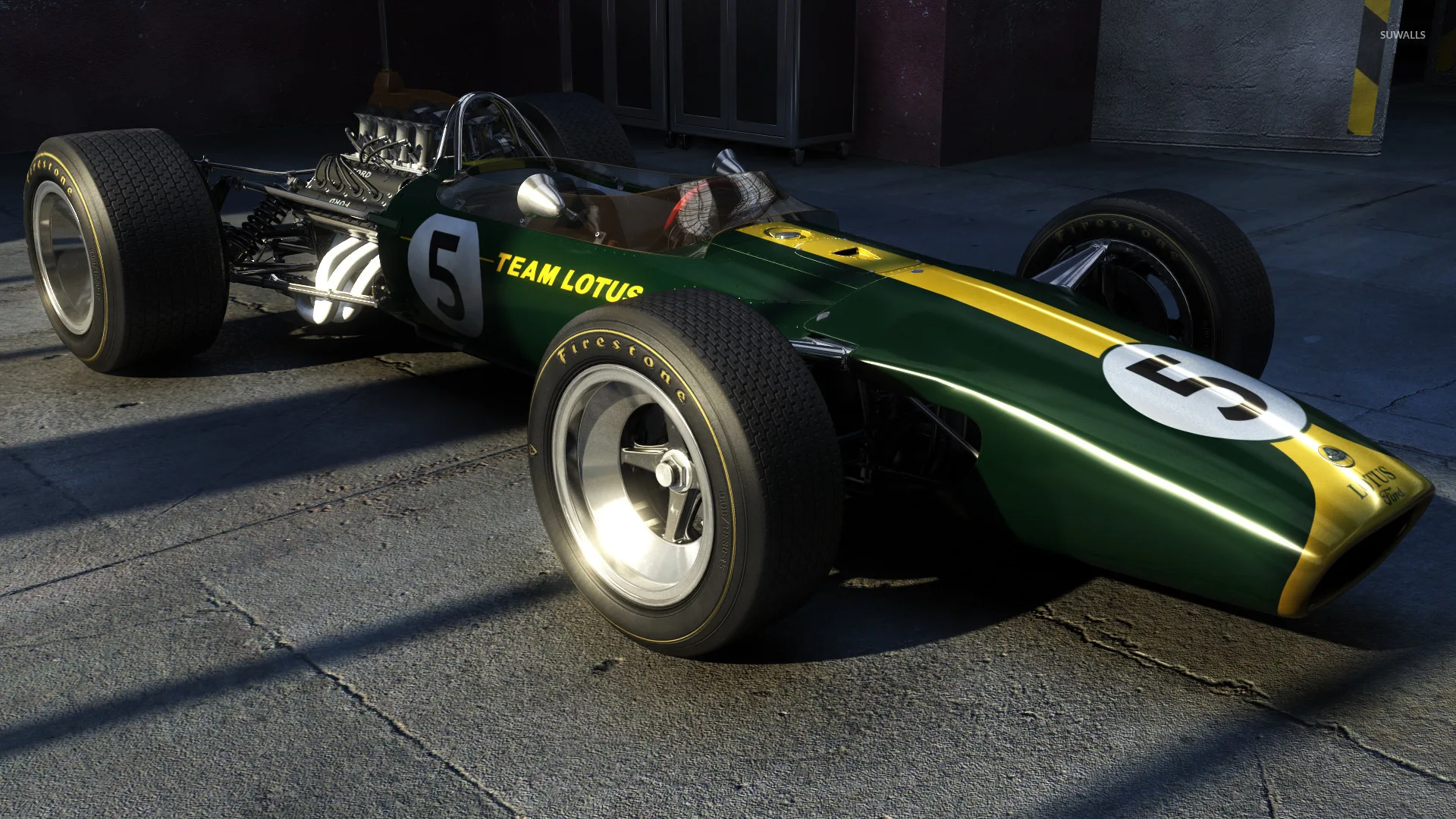
His career was not limited to single-seaters. Clark also raced the Lotus Cortina in touring-car competition, sports cars including the Lotus Elite, and machinery from Jaguar and Aston Martin earlier in his rise. This variety matters because it reveals adaptability: the balance, power delivery, tyres and racecraft required by a saloon car were not the same as those of a lightweight Formula 1 machine.
See the specifications and historical role of the cars driven by Jim Clark.
What made Jim Clark’s driving style special?
Clark’s driving was defined by smooth inputs, precise placement and the ability to remain fast without looking visibly aggressive. Observers frequently described an economy of steering movement and a sensitivity to grip. That did not mean he drove slowly or conservatively. It meant the car was disturbed only as much as necessary, preserving momentum and reducing stress on tyres and mechanical components.
His versatility is evidence that the technique was more than a perfect fit with one Lotus. Clark won on road circuits, high-speed tracks and Indianapolis’s oval. He performed in wet conditions and across Formula 1, Formula 2, touring cars and sports cars. The common element was rapid adaptation: he could identify the available grip and operate near its limit with little apparent wasted motion.
This is also why cross-era declarations need restraint. Modern drivers train differently, use safer circuits and race technically complex cars across longer seasons. Clark faced greater mechanical uncertainty and moved between categories more often. Rather than claiming that one driver would inevitably beat another in equal machinery, it is more defensible to say that Clark demonstrated an exceptional level of mastery within the demands of his period.
Our visual guide examines Jim Clark’s helmet and racing style, including the blue-and-white identity preserved by the Jim Clark Motorsport Museum.
Why is Jim Clark considered one of the greatest racing drivers?
Clark’s standing comes from five connected qualities: a high winning rate, exceptional qualifying speed, dominance during championship seasons, success outside Formula 1 and the testimony of respected contemporaries. The Jim Clark Trust records Juan Manuel Fangio’s assessment that Clark was the greatest driver he had seen. Such judgments remain subjective, but they show the esteem in which another world champion held him.
- Peak dominance: seven championship wins in 1963 and six in 1965 despite missing Monaco.
- Qualifying speed: 33 poles in 72 Grands Prix.
- Versatility: victories in Formula 1, Indy cars, Formula 2, saloons and sports cars.
- Technical range: success from the Lotus 25 through the Cosworth DFV-powered Lotus 49.
- Mechanical sympathy: speed delivered through smoothness rather than unnecessary movement.
A fuller evidence-based assessment appears in why Jim Clark was so highly regarded.
What happened to Jim Clark at Hockenheim?
Jim Clark died on April 7, 1968, during a Formula 2 race at Hockenheim in West Germany. In wet conditions, his Lotus 48 left the circuit and struck trees. Motor Sport Magazine’s account notes that he had been running eighth after four laps. The precise initiating cause was never established with certainty; explanations have included a tyre failure, but unsupported certainty should be avoided.
The accident shocked motorsport because Clark was regarded as extraordinarily capable and because he had just begun the 1968 Formula 1 season with victory in South Africa. That win raised his career total to 25 and made him the outright Grand Prix victory record holder at the time.
The event deserves factual and respectful treatment rather than speculation. Our separate account summarizes Jim Clark’s fatal crash, the known conditions and the limits of the surviving evidence.
Jim Clark’s continuing legacy
Clark’s legacy survives through records, cars, archives and the continuing respect of other drivers. The Jim Clark Motorsport Museum in Duns, Scotland, presents his farming background alongside his international career. The Jim Clark Trust says its collection includes more than 100 trophies donated for public display by his parents, James and Helen Clark. Exhibits include racing cars, original racewear, film and memorabilia.
His influence is also technical. The Lotus 25 helped establish monocoque construction in Formula 1, the Lotus 38’s Indianapolis victory confirmed the rear-engined transition, and the Lotus 49 introduced the Ford-Cosworth DFV in a winning debut. Clark did not design those cars, but his performances became inseparable from their place in racing history.
Most importantly, his story retains a human contrast: a reserved farmer who became an international champion without adopting the manner of a celebrity. That combination of speed, humility and an unfinished career helps explain why interest has endured across generations. Plan a deeper historical visit through our guide to Jim Clark’s continuing legacy.
Jim Clark career timeline
| Year | Milestone |
|---|---|
| 1936 | Born in Kilmany, Fife, Scotland. |
| 1958 | Won 12 of 20 starts with Border Reivers and attracted wider attention. |
| 1960 | Made his Formula 1 World Championship debut for Lotus. |
| 1962 | Finished championship runner-up after losing the South African finale to an oil leak. |
| 1963 | Won seven Grands Prix and his first Formula 1 world title; finished second on his Indianapolis 500 debut. |
| 1964 | Won the British Saloon Car Championship in a Lotus Cortina and took Indianapolis pole. |
| 1965 | Won his second Formula 1 title and the Indianapolis 500 during an exceptional multi-category season. |
| 1967 | Won the Lotus 49’s debut at the Dutch Grand Prix and produced his celebrated recovery drive at Monza. |
| 1968 | Won the South African Grand Prix, then died in a Formula 2 accident at Hockenheim on April 7. |
| 2019 | The modern Jim Clark Motorsport Museum opened in Duns. |
Frequently asked questions about Jim Clark
How many Formula 1 championships did Jim Clark win?
Jim Clark won two Formula 1 World Drivers’ Championships, in 1963 and 1965, both with Lotus.
How many Formula 1 races did Jim Clark win?
Clark won 25 Formula 1 World Championship Grands Prix from 72 starts. He also recorded 33 pole positions.
Did Jim Clark win the Indianapolis 500?
Yes. Clark won the 1965 Indianapolis 500 in the No. 82 Lotus-Ford. He led 190 of 200 laps and became the race’s first winner in a rear-engined car.
What car did Jim Clark drive?
Clark drove many cars, but he is most closely associated with Lotus. His best-known machines include the Formula 1 Lotus 25, 33 and 49, the Indianapolis-winning Lotus 38, and the Lotus Cortina touring car.
Why was Jim Clark so good?
Clark combined qualifying speed, smooth control, mechanical sympathy and adaptability. He was successful across Formula 1, oval racing, Formula 2, touring cars and sports cars, making his reputation broader than his two world titles alone.
How old was Jim Clark when he died?
Jim Clark was 32 years old when he died at Hockenheim on April 7, 1968.
Sources and editorial note
This article uses historical information from the official Formula 1 Hall of Fame, Indianapolis Motor Speedway’s official statistics, the Jim Clark Trust and Motorsport Museum, and the Motor Sport Magazine database. Statistics are presented in their historical context and were checked on August 2, 2026.
Kozmozracing publishes independent editorial content about racing history and fan culture. Kozmozracing is not affiliated with or endorsed by Jim Clark’s estate, Team Lotus, Formula 1 or Indianapolis Motor Speedway. Any tribute-inspired products should be described as unofficial fan-created designs, not licensed race equipment or official merchandise.